Showing posts with label Studio Ghibli Retrospective. Show all posts

Sunday, 20 May 2018

Studio Ghibli: A Retrospective, Part Thirteen - My Neighbours The Yamadas


Side-Note : I started writing this article mere weeks before the death of its beloved director Isao Takahata. I am going to keep the text the same but I will be doing a little eulogy to him at the end. 

I think I've been a little bit too harsh to My Neighbours The Yamadas in the past. I mean, it's light, fluffy and was unfortunately released between two of the greatest films of all time, Princess Mononoke and Spirited Away. It's aimless, plotless, with no over-arcing theme and is basically just a series of vignettes. It is also way too long for this concept (clocking in at 105 minutes when 80 would have sufficed). It also has the barrier of the animation, seemingly being less sophisticated than other Ghibli films. However, despite all of this, I actually found myself oddly invested in this charming little film about the family life of a standard Japanese family, the Yamadas, on my second viewing. There's no great environmental message or magical whimsy - just a series of fun little shorts about this oddly likeable and well-defined family. 

Following a few years of silence after Pom Poko, Isao Takahata turned his hand to adapting the popular yonkoma (4-panel "gag" Japanese comics) series Nono-chan by Hisaichi Ishii. In a startling shift from the lovingly handcrafted worlds of previous Ghibli films, My Neighbours The Yamadas was to be the first completely digital production. This was done in an effort by Takahata to accurately re-create the style of watercolour paintings as opposed to the more traditional cel-style animation seen in previous Ghibli films. The result is a unique and gorgeously rendered film, though it was arguably mastered on Takahata's next film The Tale of the Princess Kaguya. 

So, how do I describe the plot of Yamadas when there basically isn't one? The film follows a traditional nuclear Japanese family. There is Father Yamada, Takashi, and Mother Yamada, Matsuko who fill the roles of office worker and house-wide respectively. They share their home with Matsuko's elderly mother Shige and have two children, a teenager named Noboru and a young girl called Nonoko. They also own a seemingly non-plussed dog called Pochi. The film is basically a series of vignettes, that occasionally go into the realms of metaphorical fantasy sequences, but are mostly grounded in a cartoony take on the "real-world". The shorts cover stories such as losing Nonoke in a department store, Takashi dealing with a loud group of bikers in the neighbourhood, Matsuko trying to make sushi, Shige contemplating what is little of her life is left or Noboru trying to get close to his dad. It's fairly wide-ranging and we get to see these characters in various and interesting scenarios, always returning to the humour at the centre of the film and the undying love the family have for each other. Many of the shorts are punctuated by haikus that poetically sum up the short, including ones from Basho, Buson and Santoka.

(l:r) Matsuko, Noboru, Takashi, Nonoko, Shige - the Yamadas

I think what holds Yamadas together, as opposed to being a formless mess, is the well-definied personalities of the characters. They're not ground-breaking in anyway and do fall into very traditional roles but their personalities are just ... lovely! Takashi is the over-worked dad, slightly divorced from the day-to-day life of the Yamada house-hold, but is ultimately something of a goof-ball who loves his family. Equally goofy is Matsuko, the put upon mother, who tends to day-dream and get lost in herself. Probably the most grounded is the very serious Noboru, the teenage son, who is going through big changes but is, when he lets his guard down, as equally daffy as the rest of his family. Nonoke is the cute foil to many of the family antics and has several funny punchlines to the family's antics. My favourite of the lot though is probably the grandma, Shige, who has a wicked and very wry sense of humour. 

I guess I can talk about some of my favourite stories in the film. "A Family Crisis" opens the film in a fun way, with the family accidentally leaving Nonoko behind at a local department store. The frustration and attempts to get back to the store quickly lead to some great humour though it becomes clear that Nonoko can pretty much take care of herself as she helps another lost child find his mother. It's cute and sets the tone for the film perfectly. "Father As Role Model" is a fun one, in which Takashi sees the first falling snow of the year and desperately tries to pull the family away from the TV to take a picture of them together. Another cute short, "Adolescence", sees Noboru trying to navigate his first relationship much to the interest of the female family members in the house. It ends with the lovely Basho haiku The scent of plums / On a mountain path / Suddenly dawn. "Art Is Brief, Life is Long", on the other hand, is a very solemn piece for the film, as Shige contemplates how long she has left, stating that the recently bloomed cherry-blossom trees might be that last that she gets to see. She visits a sick friend in hospital and at first seems very lively and talkative until Shige asks why she is in there and she just breaks down and cries. This is followed by the Basho haiku No sign of Death approach/In the cicadas voices and the vignette ends. I also love the one where Takashi encounters the local bike gang but I will discuss that later. 

While grounded in reality, to a degree, Yamadas makes use of fun metaphorical visuals to heighten the family life

I've heard some mixed reactions to the animation style but I'm actually very fond of it. I love collecting the Studio Ghibli art books and in particular I love the very early concept art Miyazkai and Takahata produce for their projects. These tend to be very sketchy and are painted using bold water paints. My Neighbour The Yamadas is this style basically brought to life in animation and I think it's very effective and quite versatile. The introduction to the film, where a family member reads a very rambling speech at Takashi and Matsuko's wedding, is metaphorically represented visually on screen, as the camera flies around moving from scene to scene. The sequence is brilliant. The metaphors throughout are fun and it also draws upon elements of Japanese art and culture - Matsuko and Takashi starting their married life together is represented as them starting a bobsled run; "navigating the sea of life" shows the couple on a stormy boat navigating the famous tsunami painting, The Great Wave off Kanagawa by Katsushika Hokusai; the birth of Nonoke is played out in a similar fashion to the discovery of Kaguya in the bamboo thicket from the famous Japanese myth, just as some examples. I would argue that a sequence this ambitious, with the camera flying around and morphing from scene to scene would not be possible in traditional animation without time-consuming labour. 

The best thing that can be said about the legacy of My Neighbour The Yamada's animation technique is that it led to the stunning art design of Takahata's follow up film The Tale of The Princess Kaguya. The amazing line work and gorgeous watercolour palette was used to much greater effect in that film so, in retrospective, a slightly unambitious experiment to see how the technology works makes sense. I think this is put to greatest use in the best short of the film "The Fight For Justice", which involves a local biker gang making loud noise in the neighbourhood with the constant revving of their engines. It mostly plays out as light and fluffy, like the rest of the film, but there is one very odd scene where, to increase the tension, the chibi-style figures are rendered in realistic proportions. This is where Takashi confronts the biker gang outside his home. It's very effective and ever so slightly tense as the newly heightened sense of reality in the animation makes us a little scared for Takashi. However, it's not long before Matsuko and Shige come swooping in to save the day and the animation returns to the cute chibi style, effectively defusing the situation. 

As I said in the introduction, the film is overlong and out stays its welcome. Which is a shame because what I like in the film, I really like. The characters are well defined, the animation, water colour scheme and line work have an enormous charm to them and the individual stories, for the most part, are engaging. If you want to be sucked in by a great story, Yamadas is definitely not that film; it kind of just floats along in its own little world. I didn't think it will ever be anyone's favourite Ghibli film but it's still a pleasant little experience. For the longest time this looked like it was it for Takahata, with no new film until 2016's The Tale of the Princess Kaguya which, as mentioned above, used the same technology but to much greater artistic gain. Still, if you're in the right mood, My Neighbour The Yamadas is a lovely film to spend time with. As the film ends and the characters begin to sing Que Sera Sera and they start to float up into the sky using umbrellas, you realise that actually you have formed a close connection with them. Their simple trials and tribulations become fairly engrossing. It's a film I don't think about often but when I revisit it I like it a little bit more each time.


Quick thoughts on the dub - I don't really have any. It's been about 10 years since I've watched the dub and I don't have any strong opinions on it. Like Grave of the Fireflies, I think this one is so culturally specific to Japan, I think watching it in English is a bit of a disservice. It's got some big names, such as former SNL star Molly Shannon as Matsuko, famed voice actor Tress MacNeille as Shige and David Ogden Steirs as the narrator but I basically don't remember anything about the performances .. I'm sure it's ok.

Next time, Miyazaki returns with his most successful films and the one that would win him the Oscar for Best Animated Film thus gaining him and Ghibli new found international fame - it is, of course, Spirited Away.

And so I must address the elephant in the room. Soon after I began to write this article, I learned that Isao Takahata had passed away. Honestly, this news hit me like a ton of bricks. I have an unending respect and love for Takahata's works and all he did for animation. I will probably post a longer piece at the end of this process, perhaps as part of the Kaguya retrospective, so I will keep it short here. He was a brilliant director, a fantastic artist and a versatile story-teller. Not every one of his projects worked but it was his endeavour to try something different with each of his films that I respected the most about him. A massive talent who will be hugely missed.

R.I.P. Isao Takahata

Artist. Story-teller. Genius. 

1935-2018

Studio Ghibli: A Retrospective, Part Twelve - Princess Mononoke


Part of me wanting to write these Studio Ghibli retrospective articles was that they would present an opportunity to discuss some of my all-time favourite and most-beloved films. I stand by that Miyazaki is the greatest living filmmaker. And in 1997, he unleashed what can only be described as his magnum opus. Princess Mononoke. I'm getting shivers just writing the name of the film. It's that good.

So I've written extensively before about how Princess Mononoke tracked my whole experience of being a cinephile. I first saw the film when I was 13 or 14 and it left a huge impression on me. In fact, it was one of my earliest articles for this blog and the last one I wrote before going on a mini (read three years) hiatus. Then a couple of months ago, I declared it as my all time favourite film. So really, a lot has been leading up to writing about Princess Mononoke. Strap in because there's a lot to talk about ...

The production of Princess Mononoke can be traced all the way back to the 1970s, in which Miyazaki first sketched a princess wandering through the woods with a beast. The germ of the idea began to take shape when Miyazaki began sketching out the film in 1993 and began to produce the storyboards. Ultimately, this version of Princess Mononoke was very different to what was eventually released in 1997. After a long and exhausting war, a samurai gets lost in the forest but is helped by a giant wildcat - a mononoke. The mononoke saves the samurai but in exchange for his daughter's hand in marriage. Whilst some elements of this story were brought forward to the final product, such a Iron Town and an early battle scene, there is a distinct Beauty & The Beast meets My Neighbour Totoro vibe to it. A number of reasons led Miyazaki to abandon this version of the story - 1) It was too similar to My Neighbour Totoro in tone and style and 2) Miyazaki's world view was becoming much darker. I discussed in the Porco Rosso article how the Yugoslavia War helped to inform the tone of that film and similarly helped to shape Mononoke. Speaking to Empire Magazine, Miyazaki said that "after [the war], we couldn't go back and make a film like Kiki's Delivery Service. It felt like children were being born to this world without being blessed. How can we pretend to them that we're happy?" (1). Deciding that this vision was not in keeping with the current mood of the time, Miyazaki abaondoned the project. If you're at all interested, Viz Media released Miyazaki's outlines and drawings as a gorgeous storybook edition a couple of years ago, retaining his original pictures, entitled Princess Mononoke: The First Story.

To get his creative juices flowing again to get past his writer's block, Miyazaki agreed to do a first for the studio - design and animate a music video. On Your Mark is an under-discussed part of the Ghibli canon but it's quite an important one. It's fairly difficult to find but if you know where to look (any good anime streaming site should have it) you'll be track it down and it's well worth your time. The video was produced to accompany the then popular Japanese rock duo Chage & Aska (having sold 31 million albums and singles in Japan) and is basically a short film. The video is non-linear and tells the story of two policemen who infiltrate a religious cult and discover a winged girl, akin to an angel. She is quickly whisked away to a lab, so the duo decide to hatch a plan to rescue and release the girl. The song itself is ok but the accompanying video is nothing short of a masterpiece of its form. In four minutes, Miyazaki crams in an emotionally engaging story line with some great sci-fi world building (think Blade Runner meets Akira meets Nausicaa of the Valley of the Wind). The video was widely praised for its brilliant animation and is actually an understated key turning point in how Ghibli formed its worlds - this is the first product they produced that made use of CGI. While still mostly hand-drawn, On Your Mark uses CGI to extend backgrounds and create a sense of motion not possible in 2D animation without incredibly time consuming, and costly, labour. The techniques learned here would be used directly in Princess Mononoke and pretty much all future Miyazaki productions (until the back-to-basics Ponyo). In any case, if you can hunt the video for On Your Mark down, it is well worth it. It's about as perfect a short film as you can hope for. With his writer's block sorted, Miyazaki was ready to embark on the journey to creating the most financially successful film ever released in Japan at the time.

The original concept for Princess Mononoke took a drastically different tone and narrative route

On Your Mark is an underrated and often forgotten piece of Ghibli history

As Princess Mononoke began to take shape it soon became clear that this was the single most ambitious project the studio had ever taken on. With a massive ballooning budget, Princess Mononoke produced a staggering 144,000 individual cels that make up its 130 minutes running time, with Miyazaki personally correcting or re-drawing 80,000 or them. But it was more than just the massive budget and huge time consuming process of animating it. Princess Mononoke was quickly morphing into the darkest and most challenging story Miyazaki had ever tackled. Compared to the director's previous works, the more serious and adult tone of Princess Mononoke was a direct reaction to the atrocities of the Yugoslavian War, as mentioned earlier. While initially unsure if children should see the film, Miyazaki eventually came round to the idea that is was important for them to see this one. While Totoro and Kiki dealt in large part of themes of growing up, Princess Mononoke is much grander in scale with its concerns - the environment, tradition vs. progress, life etc. These elements have been present in Miyazaki's previous films but are fully explored at the forefront of the text in Princess Mononoke. Yet it never feels weighty or self-important - it just feels like an ancient tale you might have heard a long time ago.

Princess Mononoke doesn't spend a long time getting us sucked into its violent and dark world, set in feudal Japan. While on patrol around his village, Prince Ashitaka must defend his homestead from a furious rampaging boar-god covered in an off-putting and sickly corrupting mess of tentacles and goo. And it is absolutely thrilling. The perfect way to open a film. This disgusting mess soon envelops Ashitaka's arm, leaving behind a visible dark mark that is slowly creeping up his body. After defeating the beast and speaking to the local soothsayer, Ashitaka's prospects look grim. The only clue to how the beast came into being and where it came from comes in the form a bullet lodged in its side, which is traceable back to an iron town making a name for itself far to the west. The young prince takes it on himself to leave the village and find answers as to why the boar became so enraged in the first place and perhaps find a cure to his curse. "To see with eyes unclouded", the ancient soothsayer says. And already we're in the realms of iconic scenes. Ashitaka cutting his hair in front of the village elders, a Japanese way of saying "I am dead to you" is a culturally powerful and beautiful send off as our hero begins his quest. And that's the first major point I want to make about why I love this film - the culturl specificities. This is a story so intrinsically Japanese in the way it channels tradition, history, spirituality and culture.

Under the cover of darkness, Ashitaka begins his journey to the West as we the audience take in the gorgeously painted vistas and the soaring Joe Hisaishi musical score (the soundtrack is absolutely phenomenal by-the-by). However, we soon find that this world is the not usual Miyazaki fare. For the world of Princess Mononoke is cruel, violent and ruthless. Ashitaka's first encounter finds him in a middle of raid on a small village, as blood-thirsty bandits move in to pillage the citizens in a scene which easily could have been lifted from a Lone Wolf and Cub film. The scene is complete with Ashitaka, armed with an increased strength gifted by his curse, severing heads and arms off the bandits. Definitely not the stuff of the gentle worlds of Totoro and Kiki. The wide-spread violence of Princess Mononoke is a definite reflection of the hardening world view of Miyazaki in the face of contemporary genocides and massacres. The hero in a Miyazaki film is now a murderer and works as part of the film's general moral ambiguity towards it characters. None of the characters are painted as villains, just confused people trying to do their best to protect whatever little ground they have found in life. This can easily be seen in Jigo, the travelling monk, who befriends Ashitaka following an incident where the young warrior shined a gold piece in the face of a stunned shop owner in the next village over. He is a weary reflection of the traditions of the old Japan reflected in this character which turns into a vindictiveness as the film goes on. I would even lobby the same ambiguity to Ashitaka. I would argue that in the beginning of the film his actions are purely driven by a need to lift the curse, until he throws himself into the centre of the conflict between Lady Eboshi and the forest (more on that later) and realises he is part of something bigger.

Incidentally, I love the scene where the two share rice soup, setting up camp in the middle of a deserted village. There's a real ominous and other worldly aura to the scene which sets up nicely what is to happen next.

As Ashitaka's journey continues, he soon discovers some distressed men from a local iron mining town (which might be where the bullet came from), who have suffered terrible wounds in a recent encounter with the local wolf pack and the mysterious Princess Mononoke. With his interest peaked by the iron town and his need to help the men, Ashitaka begins to lead them through the a forest inhabited by the kodamas, cute woodland spirits that seem to terrify at least one of the close-minded iron town workers. The kodamas help to guide the group through the forest, until they come to a clearing off the bank of a river. Here Ashitaka spies the infamous wolf pack and their adopted human daughter, Princess Mononoke, who we later learn is called San. San serves as the crux of the whole inner conflict of the film. Discovered by the giant wolf Moro and her cubs as an abandoned baby, San was raised as a wolf (not dissimilar to Mowgli) and as such has lost touch with her human side. We are first introduced to San sucking the blood out of an injured Moro. The blood smeared over her face being a key indicator of her ferality and how far she has distanced herself from her own kind. It is probably one of the most iconic introductions to a character in the history of animation. San is a wonderful character, who learns to reconnect with her human side across the course of the film and one of the all-time great female protagonists of animation, instantly iconic and powerful.

The oddly quite cute kodomas became instantly iconic characters 


San instantly became one of the most iconic characters in animation
Following this encounter, Ashitaka eventually makes it the iron town. The townsfolk seem to friendly enough, with a strong female presence working the forges in a time when this was not expected of them. Ashitaka soon begins to form a picture of how this Iron Town took advantage of its location (an island in the middle of a lake surrounded by the forest) and forged its fortune. However, we learns from a local village that they recently burned a significant part of the forest and drove out the local boar god, shooting it with their newly acquired guns from China. Putting two and two together, Ashitaka correctly concludes that the boar that ravaged his village and cursed him was sent into a fit of blind rage following him being gravely wounded by these guns. Ashitaka storms to meet the leader of the town, Lady Eboshi.

So we come to Lady Eboshi, ruler of the town and one of the most nuanced and interesting "antagonists" in film, or even fiction in general. You see, like Ashitaka and San, Lady Eboshi is not a bad person. She is ambitious, clever and fearsome, in a time when women were expected to be none of these things. She forged an incredibly rich and successful mining town with some fairly progressive values that gives work to some of the most underprivileged in feudal Japan. Low-lives, former prostitutes, leapers etc. - basically, people viewed as human trash in built-up towns and settlements. Lady Eboshi takes them, gives them a job and a purpose. She puts the women to working the bellows, stoking the fires to keep Iron Town running. Yet, for her many strong values, Lady Eboshi is also a destructive force, with little to no regard for the ecological and spiritual impact on the landscape around her. While she believes in the existence of spirits, her developing plan of effectively killing and decapitating the local Forest God (the ultimate way of showing there is no force that can stop her) is a clear sign that she fears neither traditional values such as state and God. Indeed, in his first encounter with Lady Eboshi, Ashitaka almost strikes the leader down in a fit of fury brought on by his curse. However, until she tries to behead the Forest God, I don't think there's a vindictiveness to her. She is merely trying to forge the best possible lives for the community that surrounds her and no shogunate army or forest spirit is going to stop her.

Lady Eboshi - one of the all time great characters of fiction

The first act reaches its climax as San infiltrates Iron Town with the intention of killing Lady Eboshi for all her indiscretions against the forest. This is really where the film's central themes begin to blossom. It becomes clear that Princess Mononoke is a story dealing with environmentalism and spirituality. Indeed, the central conflict of the film, advancement (Iron Town) and tradition (the Forest), seem to reckon with these very concepts, each threatening to upend the other. On the one hand, Lady Eboshi's Iron Town is a very progressive society, forged through hard work and unending human desire to live, but this comes at the cost of the natural world and further political machinations. Indeed, Lady Eboshi's expansionist policies have brought her into direct conflict with the local lords of the region, leading a small-scale war. On the other hand, the characters of the Forest represent tradition and it is important that this be kept alive. Most people view Princess Mononoke, myself included, as a sneaky remake of Nausicaa of the Valley of the Wind. While I am very fond of Nausicaa, I do think it paints the conflict as too black-and-white. The silly humans just need to learn their lesson that you don't mess around with nature. The ultimate disaster at the end of Princess Mononoke comes from humans trying to play God but I would also argue that the wolves and various other animals spirits of the Forest don't help themselves in being unwilling to work with the humans to achieve ultimate balance. Thus, Ashitaka represents a force willing to jump in and find some kind of middle ground, interrupting and stopping the fight between San and Lady Eboshi. Ashitaka, seeing what hatred from both sides can bring, now seeks to find a middle ground - where Iron Town and the Forest, advancement and tradition, reality and spirituality, can find some kind of balance.

Anyway, following the conflict in Iron Town, Ashitaka is brought to the centre of the Forest by San, Moro (San's foster mother) and the other wolves following a grave injury incurred in the conflict and he essentially dies. However, the God of the Forest arrives to breathe life back into the young warrior in a truly powerful and beautiful scene. The Forest God is just a perfect piece of design work. We see in the film two versions of this creature. One is a strange and giant globular mass and another is the iconic deer like creature for when he needs to interact in the material world. The character never has any sound-effects associated with it and has a very limited amount of facial animation. Something that I only picked up on a second viewing was the subtle coding of the aura of the God. With every step he takes new flowers and plant life bloom but as soon as he step away, this new life quickly wilts and dies. The Forest Spirit can just as easily take life as he can give it. Again, it is that central conflict between two worlds that defines the narrative and thematic arc of Princess Mononoke.

The Forest God is a perfect piece of design, at once peaceful, yet also other-worldy and mildly off-putting

From here, we go from classic scene to classic scene. San nursing Ashitaka back to full health by chewing his food for him is a beautiful scene and works to bring the two of them together (with them eventually falling in love). Jigo also gets re-introduced into the film and is revealed to be an agent of the government, seeking to kill the Forest God and return its head to the Emperor of Japan (believing it gifts immortality). Jigo is revealed to be a much more sinister character than they way he is set up earlier in the film and, I would argue, is closet the film gets to a real antagonist. Essentially, Lady Eboshi has been dogged on to kill the Forest God, the ultimate representative of the natural world in the film, by Jigo who has taken advantage of her dominating personality.Their encounter with the angry boar tribe, seeking retribution for the death of their leader in the opening of the film, is thrilling and kind of morbid, especially when the new leader (the blind Okkoto) gets in involved. This leads to their traumatic assault on Iron Town as they run straight into a trap killing most of the army and is probably one of most harrowing scenes Miyazaki ever committed to film. Then there's the blooming relationship between Ashitaka and San. I love the scene where Moro berates Ashitaka for thinking he can connect with San's human side. Also, just this bit of animation of Moro laughing is fantastic.


If I have one slight criticism of Princess Mononoke (and it is very slight), I do think the second act gets a little formless but it does all pay off because the scenes are fantastic and it leads into one of the best third acts I think of in a film. There's plenty to discuss, and loads of scenes I wish I could go into from this section, but this article is long enough now and I wanted to give a broad overview of my favourite aspects of the film.

The film then begins to reach its dramatic conclusion. Following the destruction of the boar clan, San attempts to lead Okkoto back to the Forest God (being a few of the only survivors) in the hope that the Forest God can heal the boar god's wounds. However, following a nasty trick by Jigo and his hunters, Okkoto soon succumbs to same rage that consumed his predecessor. The Forest God eventually appears and gifts Okkoto with a peaceful death. However, Lady Eboshi and Jigo (in hiding in the central grove) use this as the opportunity to kill the Forest God.

So, Lady Eboshi has blown the head of the Forest God. And soon things take a really bad turn. The whole forest begins to decay as the kodamas begin to die along with the rest of the forest, their eerie bodies floating down like a snowflake. The colour palette changes to a gross brown/purple as it appears as if the whole world is dying and a black amophorous mass begins to sprout from the body of the dead Forest God.  It soon becomes clear that this mass is looking for its head. Our characters scramble to try and avoid the now expanding mass, desperately trying to escape this bizarre phenomena. Even crazier, the severed head of Moro (on the brink of death in the previous scene) seemingly comes back to life and bites off Lady Eboshi's arm (echoing a sentiment the character says earlier in the film "cut off a wolf's head and it still has the power to bite"). With Hisaishi's strange off-kilter soundtrack and the over-worldy animation, this is just a truly unforgettable sequence. The forest has been destroyed and all hope seems to be lost. Ashitaka ultimately concludes that the only way to stop this thing is to return the head to the now formless mass spreading across the forest. Ashitaka and San work to reach the highest summit of the landscape and declare that they are returning the head. And this is the really beautiful element. It takes two broken people from both sides of the conflict coming together to resolve the crisis. And the music cue that swells as Ashitaka and San hold the head up just gives me the biggest goosebumps. This is honestly one of my favourite conclusions to any film. The head is returned and a huge rumbling rips across the landscape, the scene fading to white.

The Forest begins to die in the face of the loss of the Forest God

Balance, ultimately, becomes the key. Progress needs to go hand-in-hand with preservation with a mutual respect toward each other. San and Ashitaka awake to find that the destroyed countryside has been revitalised. The grass and the flowers re-grow in front of our eyes as greenery returns to the landscape. And Joe Hisaishi's gorgeous piano motif kicks and the goosebumps just run up my spine. San and Ashitaka, whilst forming an unbreakable bond, admit that it would be difficult for them to co-exist together. San commits to looking after the forest and Ashitaka will help the remainders of Iron Town to re-grow. Lady Eboshi, sitting with what is left with the community she forged in the green ruins of Iron Town, promises to carry out a more sustainable settlement, one that keeps in mind the needs of the forest. And as the final shot, we return to the forest as one of the kodamas returns. Life must continue. Live. Fade to black.

Live.

Princess Mononoke's release in Japan in 1997 was unprecendated. The film received rapturous applause, critical praise and audience adoration. It quickly became the most financially successful film of all time in Japan, until the release of James Cameron's Titanic a few months later. Princess Mononoke eventually won the Japanese Academy Award for Best Picture, being the first animated film to do so. The film was also submitted by Japan to the US Academy Awards as their selection for Best Foreign Language Film, but alas was not picked up.

If you haven't gather yet, I think Princess Mononoke is a phenomenal film. Every single frame is a gorgeous work of art. The characters are all brilliant, wonderfully fleshed out and doesn't shy away from presenting them as morally ambiguous. It is such a rich film that demands to be watched several times. It's the only way to take in the full beauty and majesty of Miyazaki's accomplishment. More for animation, it is proof that the art form can be more then funny animals and singing princesses (not that there's anything wrong with this, of course). For many, it is a special film - one that launched hundreds of thousands of anime fans and film lovers worldwide. Princess Mononoke is just as sophisticated as some of the works of the all time great films. It is a giant to be reckoned with and is almost a perfect film.


And then there's the dub, which is well worth exploring. Princess Mononoke has the distinction of being the first Ghibli film to get a wide release English dub with a very impressive cast. Bought up by the now infamous Harvey Weinstein as part of Disney's subsidiary company Miramax (now defunct), the now disgraced producer met with Miyazaki to discuss a wide North American release of the film. Weinstein demanded several cuts be made to the film, reportedly to reduce some of the more violent scenes. Following the meeting, Studio Ghibli producer Toshio Suzuki sent Weinstein a katana blade in the post with a note attached to it - "No Cuts". Thus, a new film legend was born and Princess Mononoke was released on a very limited run in 1999, to a small box-office return.

Adapting a script from a foreign language to English is hard. It's more than just translating word for word what the original script says. Things that make sense in the context of the Japanese language can be lost when translating to English. Then it's keeping the original author's intention whilst trying to fit that into enough syllables to match the pre-rendered character mouth movements. It's a tricky job, definitely, but Mononoke's English script and dub largely pulls this off perfectly, with a dub cast that almost matches the original. The masterstroke here though was hiring fantasy author Neil Gaiman to adapt the script. Gaiman, as an author, has a real love of exploring ancient myths and legends and reinterpreting them in a modern setting (see American Gods or his wonderful collaboration with Terry Pratchett Good Omens, where, similar to Princess Mononoke just Westernised, figures of Biblical literature interact in the human world). Princess Mononoke draws upon numerous sources of Japanese lore to create a stylised version of its past where myths about gods and spirits interact in a vaguely familiar historical setting. I almost view is as similar to Tolkien and The Lord of the Rings, who imagined his own pre-history fantasy world to explain how we got to where we are now. So, Gaiman is the absolute perfect writer to adapt a script - an author with a proven track record of understanding the importance of myths and legends. He had the unenviable job of finding English words that matched the intention of the original Japanese - the shishigami became Forest Spirits, as an example. The rationale for this being there simply is no word in English that can convey the original meaning of shishigami, so Forest Spirit it is.

Anyway, you probably want to here more about my thoughts on the English cast as opposed to rambling about the intricacies of translating from Japanese to English. Overall, this is an excellent dub - truly excellent. Billy Crudup is pitch perfect as Ashitaka. Clare Danes is brilliant and feral as San. Minnie Driver is pitch perfect as Lady Eboshi, understanding the moral complexity of the character. Billy Bob Thornton channels his conferential persona into a quiet and fairly subtle performance as Jigo.

An interesting change in the dub is how they handle Moro. In Japan, it is quite normal for a male to a voice a female character - just one of them culturally specific things. So when San's mother Moro speaks with a male voice in the Japanese dub, it's quite appropriate and not surprising. To an English viewer though, this can be somewhat perplexing. Quite wisely in my opinion, they decided to use a female voice for Moro in the English dub, employing Gillian Anderson in a brilliant take on the character. You could go on about how this isn't in keeping with the original author's intent but remember - dubs are adapting the script and performances from Japanese to English to suit the English-speaking audience who is going to see it and sometimes that does mean losing some of the original culturally specific details. There are several example of this in Princess Mononoke - Jigo complains that a bowl of rice tastes like "water", which is a cutting remark in Japanese but doesn't have the same bite in English - thus the rice tastes like "donkey piss" in the dub. Another interesting cultural change is Kaya, briefly seen in the opening of the film. In the dub she is Ashitaka's sister however in the original dub she is Ashitaka's bride-to-be (not blood related!). See, Kaya calls Ashitaka anisama which can mean brother but can also mean follower, simply by the fact that they live in the same village. To avoid this potential minefield, Gaiman changes it so Kaya is simply just Ashitaka's sister. Outside of Mononoke, a good example I like to use is in Kiki's Delivery Service. When Kiki first goes to the bakery and enjoys a warm drink with Asano, the Japanese script is clearly kohi - coffee. Now I don't know how Japan views this but it's somewhat inappropriate to give a child coffee in the West. Thus, the dub changes it to hot chocolate, which is a bit more age appropriate. Even the English subtitles on the Japanese version keep this as hot chocolate! Most of the time, two scripts are made for anime dubs - one, more accurate one to go along with the Japanese version and another which is just a standard set to match what the English dialogue is. Remember that English dub scripts have to morph the meaning to match the movement of the pre-rendered character mouth movements, so a more accurate English translation is presented to go along with the Japanese presentation. So even retaining "hot chocolate" on this set is an interesting little detail in key cultural differences. If you learn anything from this it's that dubs are adaptations not direct translations.

References

(1) "Miyazaki on Miyazaki: The Animation Genius On His Movies" https://www.empireonline.com/movies/features/hayao-miyazaki/ (accessed 17/03/2018)

Saturday, 17 March 2018

Studio Ghibli: A Retrospective, Part Eleven - Whisper of the Heart


The meta-narrative of Whisper of the Heart is the story of the film's director, Yoshifumi Kondo. Kondo served as much a key part of the Studio Ghibli narrative as Miyazaki, Takahata or Suzuki. Born in 1950, Kondo became associated with Miyazaki and Takahata early on, working on TV projects such as Future Boy Conan and Anne of Green Gables. He was eventually promoted to character designer on the TV series Sherlock Hound in 1980. Following a spate of inactivity in the mid-1980s, due to recovering from pneumonia, Kondo re-joined his former animation comrades at Studio Ghibli in 1987 where he was quickly promoted to animation director on Kiki's Delivery Service, Only Yesterday and, eventually, Princess Mononoke. While a huge chunk of the gorgeous animation can be attributed to the visions of Miyazaki and Takahata, Kondo had to actually execute this vision. A hugely important role. The studio's faith was so strong in Kondo, that they gave him a project of his own to direct, Whisper of the Heart, released in 1995. The 1990s was period when Ghibli really began to consider their legacy for the first time. Kondo was expected to become one of the top directors at Studio Ghibli and, eventually, Miyazaki and Takahata's successor. However, following the conclusion of production on Princess Mononoke in 1997, Kondo died the following year of aortic dissection. His death is said to have been caused by excessive work and contributed in part to Miyazaki deciding to retire from filmmaking in the late 90s. While he would eventually return to the studio for Spirited Away, Kondo's death was the catalyst to work at a more relaxed pace at Ghibli. This leaves Whisper of the Heart as the only film in Kondo's filmography, a bittersweet epitaph to a clear animation genius. 

Yoshifumi Kondo 1950-1998
So how does Kondo's only film hold? Pretty well actually. While it's a bit slight in places and takes a while to get going, Whisper of the Heart slowly builds into a lovely film about the teenage experience, yearning, learning to take responsibility, overcoming depression and, ultimately, working towards attaining one's aspirations. Based on the manga series Mimi o Sumaseba, by noted shojo author Aoi Hiiragi, it is a great encapsulation of  where Studio Ghibli were in the 1990s, telling a subtle story placed very much in the real world, with only hints of the fantasy elements that distinguish their previous works, along with a very mature art design and approach to the animation.

Shizuku is a sullen 14 year old struggling with many of the usual teenage problems - family life is a bore, with both parents busy pursuing a career in education and a sister away at college, the pressures of school life and exams encroaching with her every step, hanging out with her friends and trying to avoid that one really obnoxious boy she can't stand. Hormones have hit Shizuku hard and her only solace is her books. She also seems to enjoy writing. Her school friends take great delight in her translated version of the John Denver classic Take Me Home, Country Roads, which is reinterpreted to be about her feelings being, basically, depressed (she has, however, done a more comical version called Concrete Roads, poking fun at the urban diaspora of Tokyo). But there's something ... missing in her life. She admits that even reading doesn't make as happy as it once did. Hrm. 

Honestly, what saves the slow moving first act of Whisper of the Heart is the characterisation of Shizuku. She might be the most nuanced of all the Ghibli heroines. She's a bit lazy, unambitious and is battling with her hormones but she is kind, understanding and sweet. She can be somewhat selfish at times but she is ultimately more intelligent than she realises. Shizuku eventually uses her daydreaming to her advantage, when she starts to draw this into her writing. It does soon become apparent that Shizuku has some form of depression that comes from a yearning to complete ... something. 

Whisper of the Heart is a great addition to the Ghibli canon. Whilst not a personal favourite, it has so much going for it  that it definitely warrants multiple watches

Things start to change when Shizuku notices that every book she borrows from the library has the same name on the check-out card - Seiji Omasawa. Getting swept up in one of her fantasies, she almost imagines this idealised young man in her head. Her yearning for adventure leads her to following a cat across town she seemingly seems to be egging her on (almost lie Alice following the White Rabbit). The trail eventually finishes at an old antique shop. She meets the shop proprietor, an old man, who owns a variety of trinkets including a statue of a cat character named the Baron. She eventually realises that the old man's grandson, the obnoxious boy she keeps running into who I mentioned earlier, is in fact Seiji Omasawa. To be brutally honest, I do find the opening 45 mins or so painfully slow. There doesn't seem to be any clear goal, at least not until our lock in with the story. When it's revealed who Seiji Omasawa is, the film peaks up in interest. Seiji, as it turns out, has a rather unconventional hobby - he builds violins and dreams of studying with the greats in Italy. The revitalised narrative begins with Seiji showing off his violin playing skills by playing Country Roads. She fumbles along, trying to sing the lyrics and they are soon joined by Seiji's grandfather and friends, which turns into a musical extravaganza. Honestly, this might be one of my all-time favourite Ghibli scenes. 

The famous Country Roads scene - easily in my top 10 favourite Ghibli scenes

However, things take a sad turn. Just as Shizuku and Seiji begin to defrost their previously icy relationship and become very close, the violin maker announces that he is moving to Italy for a year to study with the masters of the craft. After finally finding the One, Shizuku faces the prospect of being alone once again. Shizuku decides to funnel her depression and loneliness into writing a novel. Seiji and his grandfather provided her with the inspiration to write a story, now she just has to complete it. This is where the wonderful fantasy sequences come into play. Shizuku imagines herself as the heroine in a wind-swept realm, accompanying the Baron on a grand adventure, as a visualisation of her laying about the narrative framework for her novel. Shizuku decides to turn the statue of the Baron into the main hero of her story, much to the delight of Seiji's grandfather, who actually has something of a sad backstory of how it fell into his posession. These fantasy sequences are just stunning, especially in the sophisticated world building and how they reflect what is happening in Shizuku's life. Invariably, her new focus takes her away from her studies and her grades at school begin to slip. Her parents offer an ultimatum - get on with your studies or finish the book. 

The brilliant fantasy sequences help to visual Shizuku laying out the track for the narrative of her novel and experience her emotions

The conclusion is sweet. On a foggy Tokyo morning, after finishing the first draft of her book, Seiji, out of the blue, returns to Japan and goes to see Shizuku. The two rush up to the top of a nearby hill to watch the dawn break. The realism of the animation here is truly breath-taking. Shizuku admits that she is not a perfect person and that there's a lot she needs to do to make her into the best version of her. The two ultimately make an unbreakable bond to support each in all their future endevours. Thus caps off Whisper of the Heart. It's not a perfect film and I certainly wouldn't recommend it for those just getting acquainted with Ghibli. However, there is a profound sense of maturity to the story-telling and animation. It's stripped back, for sure, and the first act is very slow moving but Whisper of the Heart manages to pull it back with a very emotionally gripping narrative arc. I think it's the honest sentimentality of the teenage experience that really holds it all together. Shizuku is a great addition to the pantheon of Ghibli heroes and her struggles navigating teenage life are all too relatable. At the end of the day, the film is subtle and quietly moving. As usual, every aspect of the art design and animation is perfect, with the animators clearly pouring their real life experiences of living in Tokyo and similar urban diaspora into every frame. Basically, this is the film that Ocean Waves should have been. The underrated score by Yuji Nomi is also fairly wonderfully, lending a fairy tale like sense of wonder to the proceedings. And as a debut film, it is incredibly assured. It just makes me a bit sad that Kondo was never able to follow up on this film. He was certainly a great talent and had the spark of an animation genius. 


Some quick notes on the dub and it's just a-ok. Brittany Snow is spot on as Shizuku adding a vulnerability whilst retaining her slightly more brattish but ultimately sweet tendencies. David Gallagher voices Seiji in his trademark Riku voice (yes, that's Riku of Kingdom Hearts fame, making this something of a mini reunion for the voice actors of this video game series, as Snow voiced Namine in the second instalment). Cary Elwes voices the Baron in the fantasy sequences and the rest of the cast is rounded off by established and respected TV actors, such as Jean Smart; plus Ashley Tisdale as Shizuku's best friend - because this was a dub produced by Disney in the mid-2000s!  

After four years away, Miyazaki finally unleashes her magnum opus - next time we talk about what is probably my all-time favourite film - Princess Mononoke.

Sunday, 7 January 2018

Studio Ghibli: A Retrospective, Part Ten - Pom Poko


I'll get it out of the way now.

This is the Studio Ghibli film in which magical, shape-shifting racoons use their testicles as weapons. 

And you thought Rocket Racoon was dirty...

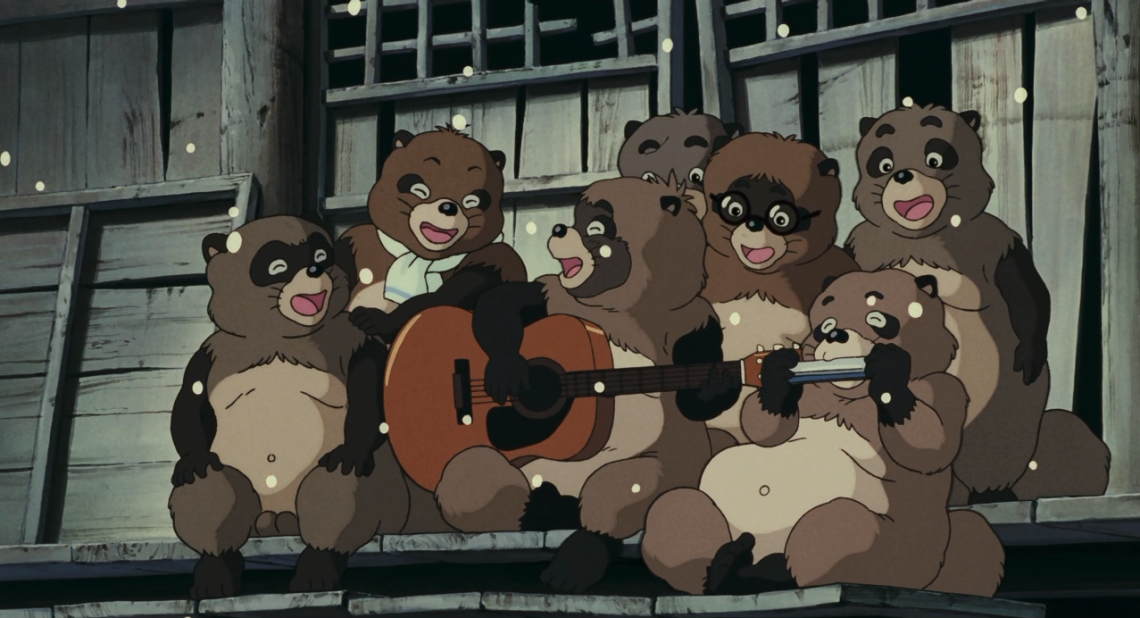
Now this is maybe crude, a bit insensitive and a way to draw my readers in but I think it's a good place to start when exploring the transnational nature of Pom Poko, Isao Takahata's third film for Studio Ghibli. So a bit of context is needed, I think, on the tanuki. Tanuki are in fact real canine animals native to Japan. Japan places an interesting emphasis on mythological creatures called yokai. These are essentially a collection of animals or demons who share magical properties. The fox is a famous example of this - this creature pops up all over Japanese mythology as sly, intelligent and came complete with shape-shifting abilities. However, by the 16th century foxes fell out of style with Japanese artists and began to focus instead on the loveable tanuki, imbuing them with some fox attributes, mostly the shape-shifting and the sneaky, mis-chief maker side. However, over the years, new attributes were added, such as laziness, eating, belly drumming and .. giant testicles. Tanuki went on to have an interesting design change over the decades but eventually became known as being fat and silly looking, leaving behind the mischievous nature of their past. And their exploits and general charm continue to delight Japan to this day. Tanuki statues are everywhere in Japan. The point of this is that tanuki are big in Japan, bigger than big - they're an everyday part of the greater pop cultural psyche. Think of them being like fairies for western children. In this regard, I think Pom Poko, from a Western perspective, is very hard to gauge with. Magical testicles is just a standard part of tanuki myths for Japanese audiences, so it should come as no surprise that this is a big plot point of Pom Poko - for a Western audience, on the other hand, this a major talking point of the film and often how conversations about it start!

Pom Poko, while having several good elements, ultimately becomes a bit of a bore

A good example of modern tanuki, which can be found all over Japan
I like to use Pom Poko as an example of how reception to a film can change according to the country and broader cultural context. To be honest, I find this element much more interesting than the film itself. Unfortunately, like Ocean Waves, I find Pom Poko to be a bit under-whelming. Overall, I prefer it to Ocean Waves, due to some great creativity and genuinely excellent scenes, but the choices on how to tell the story are genuinely baffling to me. Takahata uses this story as a springboard to explore the theme of the price of progress against the cost of nature, a recurrent theme for Ghibli but does little in terms of character or narrative.

Pom Poko follows the plight of a tribe of tanuki living near Tokyo. They enjoy a lazy lifestyle in the pristine countryside. However, disaster strikes when construction men begin to dig up their homes in the forest to make way for a large urban development project. The tanuki band together to formulate a long term plan on how to stop the humans. This includes re-learning how to shape-shift (a key aspect of the mythology and a sign of how lazy the tanuki have become) and seek the ancient masters, scattered across Japan, to help them in their time of need. However, idealogical difference begin to spring up between the tanuki as the ticking time bomb to save their homes and life-style edges closer and closer. 

Pom Poko has characters ... I think?

So the film's biggest problem is how the story is told. While there's a lot I like about the film, which mostly comes in the final act, the proceeding time is plodding and mostly directionless. Instead of having a firm central character, we continually shift to different perspectives with little time given to establish their personalities outside of a one-note character motif. This style can work. I recently saw the sweet Wonder, which shifts between multiple different characters to understand how they feel and interact with the film's main character. It's well done and works, due to the story being relatively small-scale. Pom Poko's stakes are higher, with the whole of the tanuki's homes at risk of being demolished. The lack of central character really harms this for me. The narrator as well doesn't really do much for me either. Instead of experiencing character motive, we are simply told that a character feels this way before dropping us into their situation and are then expected to care. Unfortunately, this mentality makes up most of the film. I think it's meant to evoke a historical document to give added weight to the proceedings but it just ends up making the narrative a bit dull. We see the tanuki taught by the elders of the tribe to re-connect with their shape-shifting powers and the early attempts to sway humans to their side (through violent means, which can only be described as ecological terrorism). They also send a couple of tanuki on a heroic quest to track the old masters, now scattered across Japan, to help them in their plight. And, yes, the men are also taught how to use their ball sacks as weapons.... We do have a handful of characters to follow - the bland Shoukichi, the hot-headed Gonta .... that older woman tanuki? ....Shokichi's friend? ...oh and his partner...? Then there's that one with scarf.... .... The fact is this - I've had to look up the character names on Wikipedia, even though I've seen this film three times now...The training of the tanuki makes up a huge chunk of the film and with no interesting characters to latch onto, it makes the whole thing a bit of a bore. The only enjoyable element is the animation, particularly when they begin to mimic humans. Oh, and I love their addiction to watching TV, which distracts from their training. 

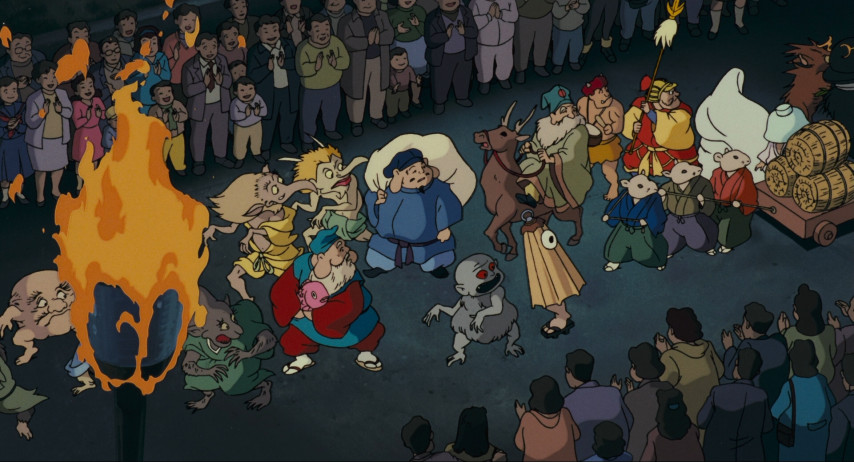
Now, that said, some elements of the film really works for me. The parade that the tanuki perform through the streets of Tokyo, to scare the residents at large to re-think the urban development plans, is a wonderful sequence and brilliantly animated. Every character from Japanese mythology can think of is here and it is a genuinely fun sequence. Now from a Japanese perspective, the illusions here are probably very recognisable from the lessons taught in primary school but to a Western audience, the scene is exotic and very strange. See that transnational element popping up again. Keep an eye out for cameos from Totoro, Porco and Kiki as well. I love that the residents completely mis-interpret the parade and a huge corporation claim it as their own publicity stunt, completely undermining the tanuki's intent. I love the sense that, despite everything they do, there is simply no stopping human progress. An interesting element crops up in the second half when the tanuki learn that fellow mystical creatures, the foxes (also shape-shifters) have integrated into human society, now working as sneaky and manipulative businessmen (perfect for the infamous creature as represented in Japanese folklore). Could this be a way out for tanuki?

Despite major problems with the problems, Pom Poko has several excellent individual sequences and a nuanced, bittersweet message about preservation of the natural world

The end is pitch perfect. After fighting and fighting for the whole film, the tanuki ultimately can't stop the urban development. Many of their comrades have died and all hope is lost. I love the scene of the one tanuki, who comes back after years of searching for one of the old masters, finds his home completely destroyed and changed. A beautiful sequence sees all the remaining tanuki come together to perform one last grand illusion, temporarily restoring the urbanised area back to it original state, to remind humans of what has been lost. However, I like the film's message that life must move on, in a bittersweet way. Some tanuki use their skills like the foxes and blend into society as normal humans. The ones who can't shape shift struggle to adapt but continue to eke out a form of living for themselves. The urban development does take into account the environmental and ecological issues that the tanuki's actions invariably brought up and turn parts of it into a sustainable green park. However, these areas are simply too small for them, so many have to leave to find new homes out in the further parts of the country. Honestly, it's a touching and well-made coda that I wish I cared about more. The points are considered and offer a balanced portrayal of the fate of the tanuki, urban development and human caused extinction...until one of the characters literally turns and talks to the camera about the importance of looking after animals and their environment...You know, we've not touched upon this yet but I really do love the way Ghibli subtlety weaves the environmental messages of their films into the narratives and doesn't hit you over the head with it ... this moment is particularly egregious because the 10 minutes before do offer a fairly nuanced take on the effects of interfering with an ecosystem, both the positives and the negatives... so this part where a character directly talks to the audience is just heavy-handed, out of place and ends the film on a sour note.

I will give Pom Poko this though - as opposed to Western ecologically heavy films, such as Ferngully, the film does not paint the humans as being the manifestation of pure evil. Just mis-informed, unaware and ill-educated. This is a good addition. 

There's a great film in Pom Poko but it's far from being a classic Ghibli

Pom Poko is a film I severely wish I could like more. I do think there's a great film in there, as evidenced by the parade and ending coda sequences. However, the decision to continually shift the perspectives means that it's hard to get a grasp on the individuals characters. This film really could have done with a central focus - a firm character that the audience follows which would then work as a springboard to explore the other personalities of the tribe. There is creativity abound in the film, especially for a Western audience new to this material. While this is fairly standard primary school stuff for a Japanese audience, Pom Poko does offer an entry way for Western audiences to engage with wider Japanese mythology. All that said though, Pom Poko just ends up feeling over long and plain dull in some parts. A few great sequences aside and some wonderful animation can't make up for a lacking script.

Next time, we get out of the mini-Ghibli rut of the early 90s with a really good one - Whisper of the Heart. Country roads, take me home ... 


Serious props to this YouTuber for his excellent video about the history and legacy of tanuki! He even explains just what the deal is with the tanuki scrotum thing... I learned a lot!

https://www.youtube.com/watch?v=icyOAc_pAvY

The English dub ... is completely forgettable. I've seen it once a long time ago and it left no mark on me whatsoever. You've got J.K. Simmons in there and the always awesome Tress MacNeille. Weirdly it also has Jonathan Taylor Thomas, who is probably most famous as the voice of Young Simba in The Lion King. 

Tuesday, 12 December 2017

Studio Ghibli: A Retrospective, Part Nine - Ocean Waves


I think the early 90s were an odd time for Studio Ghibli. With Miyazaki in semi-hiatus, while he prepared his magnum opus, and Takahata pursuing a project that was maybe slightly below him (which explored in the next article), it was time to start thinking legacy. At this point, the producers knew they had a very special film company with some of the greatest filmmakers of all time making stunning works that were rich and subtle yet with enough broad appeal to reach a wide audience. So the question became what was going to happen when these filmmakers either moved on, retired or .. passed away? Arguably, this was and still is Studio Ghibli's biggest problem - how do you replace Miyazaki and Takahata? And this isn't a question that has been hovering in recent years - this goes right back to the early 90s. This question has never really been answered and is why the studio is now all but closed (save on final Miyazaki film). There were two concerted elements in the early 1990s that actually share some common themes - Whisper of the Heart and Ocean Waves. Both films were from new directors to the studio, so both projects were big risks, and wanted to tell contemporary stories. One turned out to be a minor masterpiece and the other remained an under-welcoming oddity for years...we're looking at the latter...

On my epic binge of Studio Ghibli's back catalogue, I wasn't too enthused about re-watching Ocean Waves. There's certainly worse Ghibli films (not many though) but this one is arguably the studio at its most ... middle of the road (well maybe except for the next one). In all honesty, it's hard to get too angry at the film since it came from a genuinely sincere place. The young staff of Ghibli were given a chance to make their own film and wanted to make something contemporary- something that spoke to them. From the perspective of the heads of the studio, this was a challenge given to the young staff to produce a film quickly, cheaply and efficintly whilst maintaining a high standard of quality. This, ironically, led the film to go over budget and over schedule. Ghibli hired young filmmaker Tomomi Mochizuki to helm the project. This would be the first time Ghibli film not directed by Miyazaki or Takahata, so I imagine the pressure was on for young Mochizuki. The film was based on a novel by Saeko Himuro, which was serialized in the Ghibli-affiliated magazine Animage. The serial was complete with illustrations by Katsuya Kondo, who also served as the film's characters designer and animation director. This was also going to Ghibli's first, and currently only, feature-length TV film - the film never screened in cinemas which might explain its obscurity in the West.

Our two protagonists (l:r) Taku and Rikako

The film is set in the small town of Kochi on the Japanese island of Shikoku (off the main island of Honshu). The film follows two friends, Taku and Yutaka, in high school, who seem to have an unbreakable bond. That is until a mysterious transfer student named Rikako enters their lives. Rikako is hot-headed, rude, stand-offish, intelligent, beautiful and attracts the eyes of all the boys in school, much to the ire of the girls. And of course Taku and Yutaka fall for her which ends up splitting them apart. Whilst on a school trip to Hawaii, Rikako asks to borrow some money from Taku as she "lost her own". As it turns out, she's actually saving up for a trip to fly back out to Tokyo to see her estranged father (Rikako's parents have split up and she lives with her mother in their new home in Kochi). Taku, through a series of circumstances, eventually gets pulled into Rikako's mad trip to Tokyo, as he begins to learn to grow up into an adult. 

Ocean Waves, for me, is a little bit of a dud. This is definitely the work of a group of young filmmakers, so it's kind of hard to completely hate on it, but it suffers from an unfocused script, under-written characters and a slightly sexist under-layer. The animation is great for a TV special, though maybe slightly under the quality of a standard Ghibli film (understandable though). The background art though is gorgeous. Ghibli had not rendered never rendered modern-day Japan before and in such realistic detail. The animator's experiences of growing up the country and moving to a metropolitan city really shines through. Miyazaki himself said truly great animation can only be achieved by drawing upon experience, which is evident in the design of Ocean Waves. However, outside of the technical elements, I can't really find much to recommend about Ocean Waves. Slice-of-life stories are fine, of course, but Ocean Waves' biggest problem is its unfocused script which veers from sentimental to kind of mean. It passes by 70 minutes but the pace is fairly slow and the construction of the scenes are uninteresting. This makes it feel like a much longer film than it actually is. There's plenty of scenes that could have worked with a better structure - all the students coming back to Kochi as adults and going out for drinks as part of their school reunion is a cute sequence. The problem is that all of a sudden they are transplanted with newly found personalities and secret crushes that don't even come up in the first part of the film. As a protagonist, Taku is also fairly flat. There could have been a charming personality in there - a young man in way over his head - but there's just not a lot there to latch onto. Things start out promisingly enough, with the film exploring the friendship between Taku and Yutaka. We learn how they both protested to the school cancelling the trip but go about it in different ways - a clever way of indicating that these two are very similar but quite different to each other. However, the film seems to forget about these earlier scenes and shifts focus to Taku and Rikako hanging out together; then we're dealing with Rikako's family problems before skipping forward a few years to the old friends reconciling with each other again. There's little rhythm to get to know these people as characters and it severely hurts the film. 

There is some gorgeous art design in the film but the script is unfocused

Mostly because I don't have a lot to say about the film at a whole, I want to use this opportunity to explore some feminist critique of character tropes that cropped up while I was watching the film. I think my big issue with the film is the way the central character of Rikako is written. She is moody and angry towards the world, shunning all those around and changing her emotions on a whim but this is all really just a mask to hide her inner pain. However, I think there is something vaguely insidious to this that reinforces incredibly negative stereotypes of women that the film tries to sweep under the rug at the end. The plot of the film is essentially Taku, the dominant male character, trying to untangle the central mystery of who this complex girl is and failing - only to get her as prize at the end anyway.

TV Tropes files Rikako under the Alpha Bitch type - a category shared by characters such as Pacifica Northwest from Gravity Falls, Regina from Mean Girls and Cordelia Chase from Buffy The Vampire Slayer. While these are great examples of characters where the writers undermine the trope, they start out as representative of the Alpha Bitch trope. She is usually at the centre of attention at high school, leader of her clique, generally a rich Daddy's girl (where the family usually have some kind of massive influence), probably a cheerleader and generally acts awful to everyone around her, complete with a group of mindless friends who follow her around everywhere. Rikako certainly displays elements of this trope but it doesn't quite fill the whole picture. In fact, elements of this trope are arguably combined with another in the film - the Broken Bird. These character usually have some kind of "cynicism catalyst' i.e. something bad that happened in her past that destroyed her faith in just about everything. Lapis Lazuli from Steven Universe and Jessica Jones from her self-titled series are both examples of this trope done right - both suffer from a form of PTSD and are slowly beginning to overcome it in their own way. This trope is massively popular in anime and manga (the list is endless on the TV Topes site). Every major series you can think of has a female character that displays this trope - Evangelion, One Piece, Naruto, the list goes on. TV Tropes defines this archetype further as seemingly being emotionally experienced and her detachment gives the impression of competency but she often can't live up to this hype - which is an important aspect of Rikako's character. She's great at sport, is book smart, beautiful and stands out but struggles emotionally to connect. Basically, the film is trying to say that Rikako is "different from other girls".

Whilst Ghibli has a great reputation for writing great females characters, something when seriously wrong in the fleshing out of Rikako - a character who ends up drawing upon several tropes that are utilised to create a shallow and ultimately unengaging character 

Rikako has a mixture of both the tropes I have discussed in the way she is written. Certainly, Rikako displays elements of the Alpha Bitch - the entitlement, the disdain for everyone around here, seemingly being good at everything and all the boys wanting her however she's not exactly popular with other girls, which is crucial to the Alpha Bitch type. Truly memorable characters who fall into this trope work to overcome their issues as part of their character development. Cordelia and Pacifica break the mould of the Alpha Bitch type to become active members of their respective groups. They overcome how the world sees them to reveal intelligent and independent women, making up for her past "bitchiness" whilst not undermining who they are (until Angel ruined it all for Cordelia ... but that's another discussion for another time). Rikako in no way redeems herself from her actions in the film. She essentially steals money from two people, lies to a friend about the trip they are going on and essentially kidnaps her (Rikako convinces a friend to go away together for a couple of days though this is just a pretense to go on a last minute trip to Tokyo to see her dad) and intentionally antagonises all those around her. Then, after a particularly heated argument with Taku, she slips away and reappears right at the end of the world as a mature adult - not terribly inspiring. Then there's the Broken Bird side. She has a cynicism catalyst in that her parent's have split up and she's had to move from Tokyo. She is angry towards the world and stand-offish with everyone but is using it as a front to hide her inner turmoil. Lapis suffers from a traumatic past that helped to shape her outlook on the world and the universe however, after nearly flooding Earth, she is working on improving herself, but doesn't always succeed. Jessica Jones turns surviving her metaphorical rape into a crusade to ensure no woman suffers again at the hands of Kilgrave. What I want to make clear is that these characters start off in a certain depressed place that shape their world view but go on an arc to get work through the problem in their past. Rikako doesn't go on any kind of arc. She starts the film in one place, storms out of the characters' lives and re-appears years later as a mature woman - leaving her development up to the mind of the viewer. By robbing her of a character arc, the film ends up drawing upon two tropes that require some kind of development but just leaves the character as shallow and unengaging. Ultimately, Rikako is puzzle that the male character Taku must unravel, robbing her of any agency in what is essentially her own story and reinforces negative stereotypes about women being unreasonable, manipulative and difficult to deal with.

So there you have it - Ocean Waves. It's an interesting experiment that tried to show off what the young staff could do. Normally, I would be an apologist for this kind of creative springboard. It's great that the studio gave a chance to show the old guard what youthful talent could do and this really could the staff's time to shine. Instead, Ocean Waves aims low and doesn't sustain the landing. If you have to see every Ghibli film, Ocean Waves is certainly not terrible or anything. It's just very middle of the road with loads of untapped potential that passes by an inoffensive 70 minutes (unless you're a feminist, like me). However, then you stop and think that this is Studio Ghibli. Not all their films need to be like Miyazaki's, of course, but there needs to be something. A spark of creativity. There's no shame in producing a smaller scale story. Heck, in comparison to the works of Miyazaki and Takahata, a delicate, well-crafted coming of age tale set in modern-day Japan with a cute romance at the centre could have made for a unique, smart, subtle, moving and charming film that represented a change of pace for the studio... oh, wait...they made that one ... it's called Whisper of the Heart. That one is a couple of articles away though - basically, it's Ocean Waves done right ... Anyway - final thoughts on Ocean Waves. If you have to see it, then it's fine but there's a dozen or so better Ghibli films you could be watching instead. 

With Ghibli's new mission to find a way to continue the legacy of Miyazaki and Takahata seemingly limping out of the gate, it would be a case of returning back to the tried-and-tested formula of the old masters. Takahata's new project was finally on the horizon and hopes were high it could match the immense quality of Only Yesterday and Grave of the Fireflies...more on that next time...

No comments on an English dub this time since one is not available in the UK.